
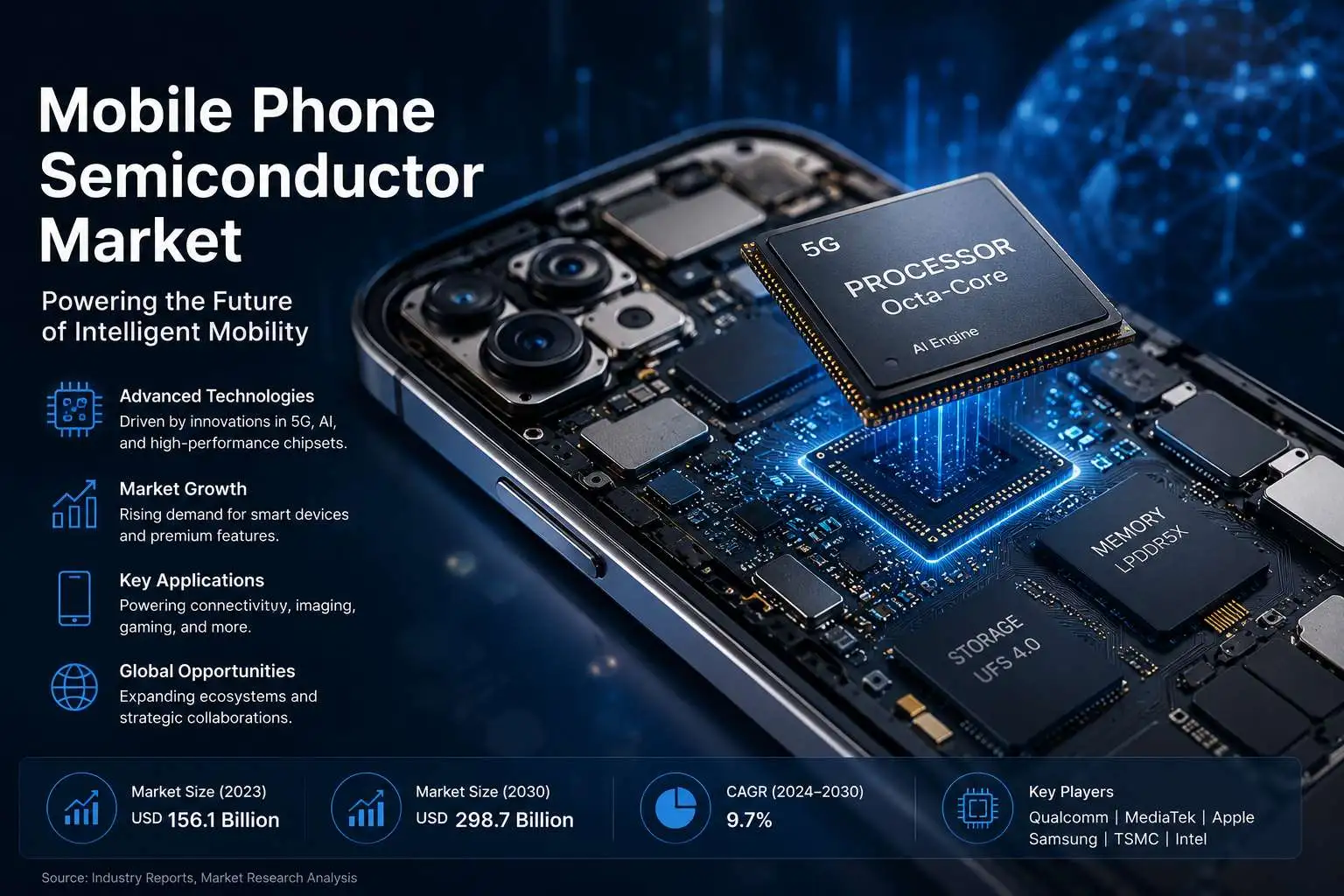
Mobile Phone Semiconductor | Smartphone Chip | Mobile Processor | Regional Breakdown | April 2026 | Source: Market Research
150B∗∗∣∗∗7.588B
Market Value by 2032 | CAGR (2026-2032) | Market Value in 2025
Mobile Phone Semiconductor Market
Key Takeaways
-
Mobile Phone Semiconductor Market is projected to reach USD 150 billion by 2032 at a 7.5% CAGR .
-
Application processors (AP) and baseband chips dominate the component segment .
-
5G smartphones are the fastest-growing segment, driving demand for advanced chipsets .
-
Qualcomm, MediaTek, Apple, Samsung, and Broadcom lead the competitive landscape .
-
Asia-Pacific dominates manufacturing and consumption; North America leads chip design .
The Mobile Phone Semiconductor Market is projected to grow from USD 88 billion in 2025 to USD 150 billion by 2032 at a 7.5% CAGR , driven by the global rollout of 5G smartphones, increasing AI processing demands for on-device intelligence, and the adoption of Mobile Processor and Smartphone Chip technologies that enable faster connectivity, advanced camera capabilities, enhanced gaming performance, and power efficiency across entry-level, mid-range, and premium smartphone segments worldwide .
Market Size and Forecast (2025-2032)
| Metric | 2025 Value | 2032 Projected Value / CAGR |
|---|---|---|
| Mobile Phone Semiconductor Market | USD 88B | USD 150B | 7.5% CAGR |
*Source: MarketsandMarkets, Counterpoint Research *
Segment & Technology Breakdown
| Component | Segment | Primary Buyer | Key Driver |
|---|---|---|---|
| Application Processor (AP) | CPU, GPU, NPU | Smartphone OEMs | Computing performance |
| Baseband Processor | Cellular Connectivity | Smartphone OEMs | 5G/4G modem |
| Memory (DRAM, NAND) | Storage | Smartphone OEMs | Multitasking, storage |
| Power Management IC | Battery, Power | OEMs | Efficiency |
| RF Front-End | Signal Processing | OEMs | 5G connectivity |
| Technology | Segment | Primary Buyer | Key Driver |
|---|---|---|---|
| 4G/LTE Chips | Established | Value Segment | Cost-effectiveness |
| 5G Chipsets | Premium/Mid-Range | Flagship Models | Speed, low latency |
| AI Accelerators | On-device AI | Camera, Voice | Generative AI, NPU |
| Smartphone Type | Segment | Primary Buyer | Key Driver |
|---|---|---|---|
| Premium ($600+) | Flagship | High-end Users | Performance, camera |
| Mid-Range ($200-600) | Volume | Mass Market | Value, features |
| Entry-Level (<$200) | Low-cost | Emerging Markets | Affordability |
*Sources: MarketsandMarkets, Counterpoint *
What Is Driving the Mobile Phone Semiconductor Market Demand?
5G Smartphone Adoption: 5G smartphone shipments surpassed 4G in 2024, accounting for over 60% of total smartphone volume. 5G chipsets command 2-3x higher ASP than 4G chipsets, driving semiconductor market growth. Global 5G smartphone penetration projected to exceed 80% by 2028 .
On-Device AI Processing: Generative AI features (live translation, photo editing, voice assistants) require powerful NPUs integrated into mobile processors. Qualcomm, MediaTek, and Apple are investing heavily in AI-optimized chips with 2-3x AI performance improvements per generation .
Advanced Manufacturing Nodes: Migration from 5nm/4nm to 3nm process technology enables better performance and power efficiency. Apple’s A17 Pro (3nm) and Qualcomm’s Snapdragon 8 Gen 3 (4nm) push performance boundaries. Sub-3nm nodes expected by 2026-2027 .
Foldable and Premium Smartphones: Foldable phone shipments growing at 25% CAGR. Premium smartphones ($600+) now represent over 25% of unit volume but over 60% of semiconductor value. Flagship chipsets drive ASP increases for suppliers .
KEY INSIGHT
|> Application processors account for the largest semiconductor component segment, representing over 35% of market value. 5G chipsets are growing at 15% CAGR, outpacing the overall market. The premium smartphone segment ($600+) contributes over 60% of semiconductor revenue despite representing only 25% of unit volume .
Get the full data — free sample available:
→ Download Free Sample PDF: Mobile Phone Semiconductor Market
Includes market sizing, segmentation methodology, and regional forecast tables.
Regional Market Breakdown
| Region | Maturity | Key Drivers | Outlook |
|---|---|---|---|
| Asia-Pacific | Largest (60%+ share) | Smartphone manufacturing, semiconductor fabrication | China, Taiwan, Korea, India lead |
| North America | Design Hub | Chip design leadership, premium smartphone demand | US leads |
| Europe | Mature | Stable smartphone replacement cycle | Steady growth |
| Middle East & Africa | Growth | 5G adoption, smartphone penetration | Moderate expansion |
*Sources: Counterpoint, IDC *
Competitive Landscape
| Category | Key Players |
|---|---|
| Integrated Chipset Leaders | Qualcomm (US), MediaTek (TW), Samsung (KR), Apple (US) |
| Memory Specialists | Samsung, SK Hynix, Micron |
| RF & Connectivity | Broadcom, Qorvo, Skyworks |
| Design IP | Arm, Synopsys, Cadence |
| Manufacturing | TSMC, Samsung Foundry |
*Source: Industry Analysis *
Outlook Through 2032
The convergence of on-device AI, advanced process nodes, and specialized compute units will define the mobile phone semiconductor market through 2032. Key trends shaping the market include:
On-Device Generative AI: Mobile processors with dedicated NPUs supporting LLMs (large language models) and diffusion models on-device, enabling privacy-preserving AI applications without cloud connectivity .
Chiplet Architectures: Disaggregated SoC designs using chiplets for modular manufacturing, improving yields and enabling mixing of process technologies (e.g., 3nm for CPU, 5nm for RF) .
Advanced Packaging (3D-IC): Heterogeneous integration stacking multiple dies (logic, memory, RF) for increased density and performance, reducing power consumption and physical footprint .
Satellite Connectivity Integration: Mobile chips adding satellite communication support for emergency messaging and off-grid coverage, expanding addressable market for outdoor and remote users .
Custom Silicon Expansion: Smartphone OEMs (Google, Xiaomi, Vivo) developing custom chips for specific workloads (image processing, AI), reducing reliance on Qualcomm/MediaTek for select functions .
RF Front-End Complexity: 5G Advanced and 6G requirements driving increased RF component count, including more antennas, power amplifiers, and filters, increasing semiconductor content per device .
Vendors investing in AI acceleration, advanced process nodes, chiplet architectures, and specialized compute units will capture the highest-margin contracts as smartphones evolve into AI-powered personal computing platforms .
Access complete forecasts, segment analysis & competitive intelligence:
→ Purchase the Full Mobile Phone Semiconductor Market Report (2026-2032)
*7-year forecasts | Segment & application analysis | Regional data | Competitive landscape*
Keywords: Mobile Phone Semiconductor | Smartphone Chip | Mobile Processor | 5G Chipset | Application Processor | Baseband Chip | Memory Chip
© 2026 WiseGuy Reports (WGR) · All Rights Reserved · wiseguyreports.com
All market projections are forward-looking estimates sourced from WGR’s proprietary research reports and subject to revision.