
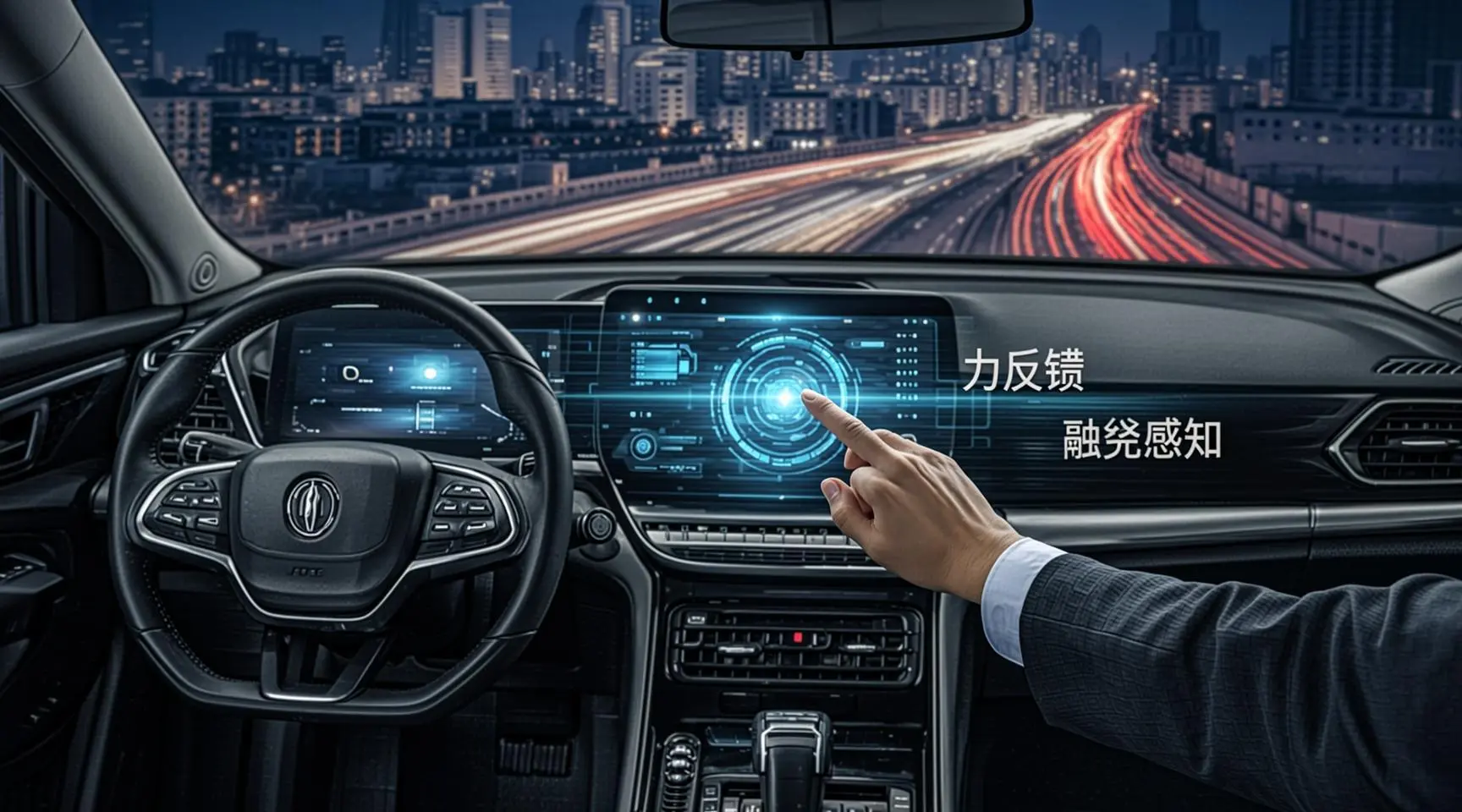
Automotive Haptic Technology | Haptic Feedback | Touch Feedback | Regional Breakdown | April 2026 | Source: Market Research
6.5B∗∗∣∗∗12.52.8B
Market Value by 2032 | CAGR (2026-2032) | Market Value in 2025
Automotive Haptic Technology Market
Key Takeaways
-
Automotive Haptic Technology Market is projected to reach USD 6.5 billion by 2032 at a 12.5% CAGR .
-
Tactile feedback and vibration motors are the dominant technology segments driving adoption .
-
Center console and steering wheel applications are leading; ADAS integration is the fastest-growing .
-
Aito (DK), Immersion (US), Continental AG, Bosch, and Valeo lead the competitive landscape .
-
North America and Europe dominate; Asia-Pacific is the fastest-growing region .
The Automotive Haptic Technology Market is projected to grow from USD 2.8 billion in 2025 to USD 6.5 billion by 2032 at a 12.5% CAGR , driven by increasing demand for enhanced driver safety and reduced distraction, the rise of touchscreen interfaces replacing physical controls, and the adoption of Haptic Feedback and Touch Feedback systems that provide tactile confirmation for driver inputs across center consoles, steering wheels, infotainment displays, and ADAS controls in passenger and commercial vehicles worldwide .
Market Size and Forecast (2025-2032)
| Metric | 2025 Value | 2032 Projected Value / CAGR |
|---|---|---|
| Automotive Haptic Technology Market | USD 2.8B | USD 6.5B | 12.5% CAGR |
*Source: MarketsandMarkets *
Segment & Technology Breakdown
| Technology Type | Segment | Primary Buyer | Key Driver |
|---|---|---|---|
| Tactile Feedback | Vibration, Force | Tier 1 Suppliers | Physical confirmation |
| Vibration Motors | ERM, LRA | OEMs | Low cost, reliability |
| Piezoelectric Actuators | Precise Feedback | Luxury Automakers | High precision, fast response |
| Surface Haptics | Touchscreen Effects | Infotainment Developers | Enhanced UX |
| Force Feedback | Steering, Pedals | ADAS Suppliers | Safety integration |
| Application | Segment | Primary Buyer | Key Driver |
|---|---|---|---|
| Center Console | HVAC, Media | Automakers | Reducing distraction |
| Steering Wheel | Controls, ADAS | OEMs | Hands-on detection |
| Infotainment Display | Touchscreen | Tech-focused Brands | Intuitive interaction |
| Touchpad/Button | Haptic Buttons | Premium Vehicles | Premium feel |
| ADAS Integration | Safety Alerts | Safety Engineers | Collision warnings |
*Sources: MarketsandMarkets, Research and Markets *
What Is Driving the Automotive Haptic Technology Market Demand?
Shift Toward Touchscreen Interfaces and Digital Cockpits: Automakers are replacing physical buttons with sleek touchscreen interfaces, creating demand for haptic feedback to provide drivers with tactile confirmation of inputs. This reduces the need for visual confirmation, keeping driver eyes on the road.
Increasing Focus on Driver Safety and Distraction Reduction: Haptic feedback provides intuitive alerts for lane departure, collision warnings, and blind-spot detection. Haptic signals reduce reaction time compared to visual or audio alerts, enhancing vehicle safety.
Rise of Autonomous Vehicles and Shared Mobility: As vehicles transition to higher autonomy levels (Level 3+), interior spaces become living/working environments requiring intuitive, screen-first controls. Haptic feedback bridges the gap between digital interfaces and familiar physical sensations.
Consumer Demand for Premium In-Cabin Experiences: Luxury automakers are leveraging haptic technology as a differentiator, offering refined tactile sensations for touchscreens, rotary dials, and gesture controls. Advanced haptic systems are becoming standard in mid-range vehicles .
KEY INSIGHT
The center console segment currently dominates the automotive haptic technology market, accounting for over 35% of global revenue. ADAS integration is the fastest-growing application, with haptic feedback steering wheels and seat vibration alerts gaining traction across mainstream vehicles. The Asia-Pacific region is projected to grow at the highest CAGR of 14.2% through 2032 .
Get the full data — free sample available:
→ Download Free Sample PDF: Automotive Haptic Technology Market
Includes market sizing, segmentation methodology, and regional forecast tables.
Regional Market Breakdown
| Region | Maturity | Key Drivers | Outlook |
|---|---|---|---|
| Europe | Largest | Stringent safety regulations, premium automakers | Strong growth; Germany leads |
| North America | Mature | Early tech adoption, autonomous driving focus | Steady growth |
| Asia-Pacific | Fastest-Growing | High vehicle production, electronics ecosystem | Highest CAGR; China, Japan, South Korea lead |
| Middle East & Africa | Emerging | Luxury vehicle demand | Moderate expansion |
| Latin America | Developing | Gradual technology adoption | Slow growth |
*Sources: MarketsandMarkets *
Competitive Landscape
| Category | Key Players |
|---|---|
| Haptic Technology Leaders | Aito (DK), Immersion (US), TDK Corporation |
| Tier 1 Suppliers | Continental AG, Bosch, Valeo, Denso |
| Actuator Specialists | AAC Technologies, Alps Alpine, Nidec Corporation |
| Emerging Innovators | Boréas Technologies, Hap2U, Ultraleap |
*Sources: MarketsandMarkets *
Segment-Level Insights
By Technology: Vibration motors (ERM and LRA) currently dominate the market due to their cost-effectiveness and reliability. Piezoelectric actuators are the fastest-growing segment, offering precise, fast response and low power consumption, ideal for high-end applications. Surface haptics is emerging for touchscreen applications .
By Application: Center console accounts for the largest revenue share, driven by increasing integration of haptic touch panels for climate control, audio, and vehicle settings. Steering wheel integration is growing rapidly for ADAS alerts and hands-on detection. ADAS integration (seat vibration, steering wheel pulsing) is the fastest-growing application .
By Vehicle Type: Passenger vehicles dominate the market, with luxury segments leading in adoption rates. Electric vehicles (EVs) are emerging as a key growth segment, as EV manufacturers prioritize modern digital interiors. Commercial vehicles are gradually adopting haptic systems for safety applications .
By Sales Channel: OEM direct (factory installation) accounts for the majority share, with haptic systems increasingly specified in original vehicle designs. Aftermarket is a growing segment for retrofitting haptic steering wheels and touchscreen upgrades .
Outlook Through 2032
The convergence of ADAS evolution, interior digitalization, and autonomous driving will define the automotive haptic technology market through 2032. Key trends shaping the market include:
ADAS Integration Expansion: Haptic feedback becoming a critical component of advanced driver assistance systems, providing intuitive collision warnings, lane departure alerts, and parking assistance through steering wheel vibration and seat pulsing.
Surface Haptics for Touchscreens: Variable tactile effects on flat surfaces enabling different sensations for different functions (scroll, click, drag), enhancing the usability of large glass panel cockpits.
Haptic Steering Wheels: Hands-on detection, ADAS alerts, and touch-sensitive controls integrated within the steering wheel, eliminating physical buttons while maintaining intuitive control.
Gesture + Haptic Convergence: Combining gesture recognition with haptic confirmation, allowing drivers to control functions with hand movements while receiving tactile feedback when commands are registered.
Lightweight and Low-Power Actuators: Development of thinner, more energy-efficient haptic actuators supporting the industry trend toward reduced vehicle weight and improved energy efficiency.
Software-Defined Haptics: Programmable haptic effects delivered via OTA updates, allowing automakers to add new tactile sensations and refine existing ones without hardware changes.
Vendors investing in piezoelectric actuator technology, surface haptics, ADAS integration, and software-defined haptic platforms will capture the highest-margin contracts as automotive haptic technology evolves from novelty feature to essential safety and user experience enabler.
Access complete forecasts, segment analysis & competitive intelligence:
→ Purchase the Full Automotive Haptic Technology Market Report (2025-2032)
*7-year forecasts | Segment & application analysis | Regional data | Competitive landscape*
Keywords: Automotive Haptic Technology | Haptic Feedback | Touch Feedback | Vibration Motor | ADAS Haptic | Steering Wheel Haptic | Surface Haptics | In-Vehicle UX
© 2026 WiseGuy Reports (WGR) · All Rights Reserved · wiseguyreports.com
All market projections are forward-looking estimates sourced from WGR’s proprietary research reports and subject to revision.